Categories
Press Releases

Climate Reality PH, East-West Center open applications for Project Niche

Climate Reality PH, East-West Center open applications for Project Niche

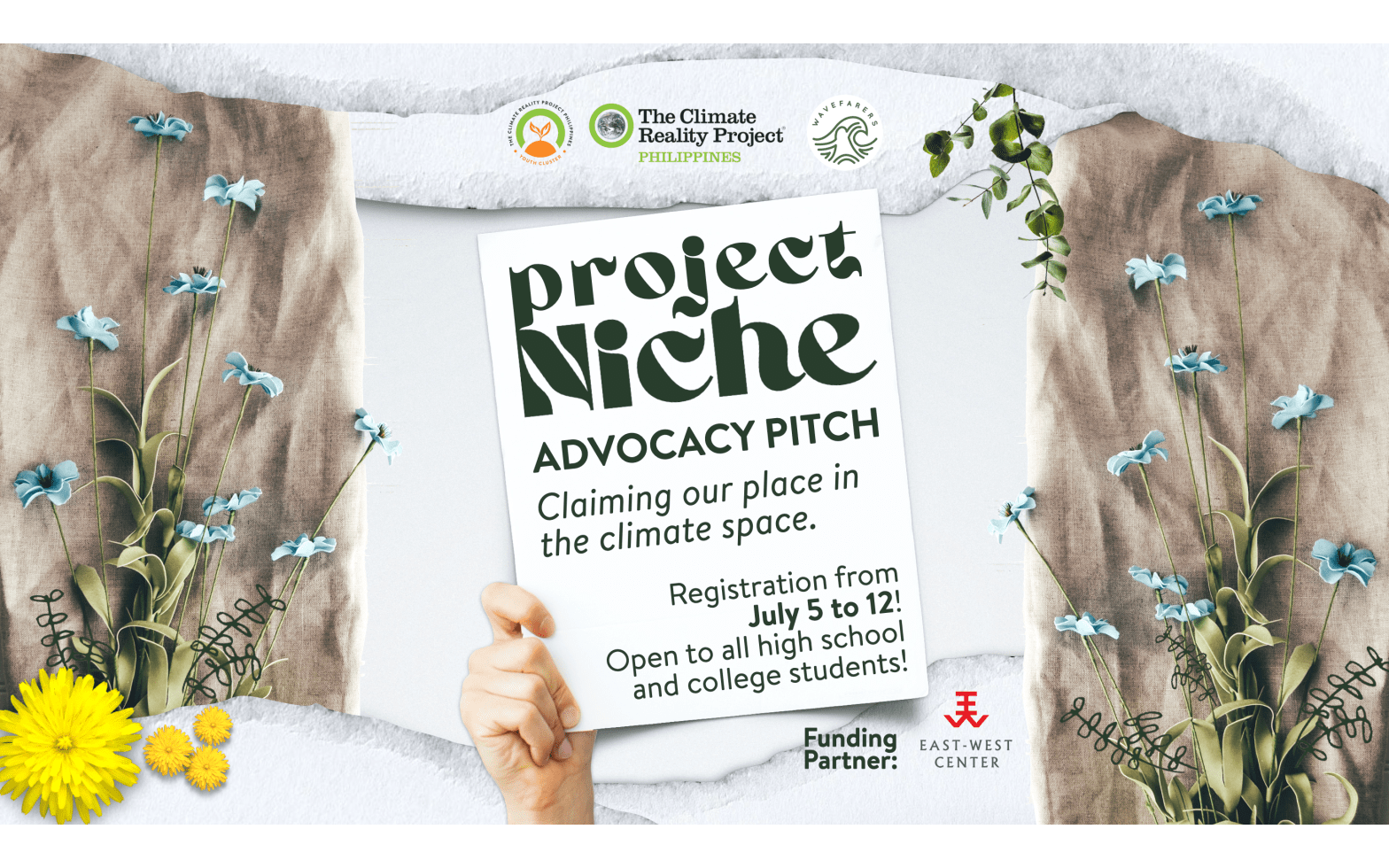
Quezon City — The Climate Reality Project Philippines, in partnership with the Hawaii-based East-West Center and youth-led environmental group Wavefarers, is inviting young climate advocates to submit project proposals to “Project Niche: Advocacy Pitch.”


Launched last July 5, Project Niche aims to empower the youth to conceptualize and implement community-based projects on climate action and sustainability. It culminates the month-long campaign of the Youth Cluster entitled “Niche 2021: My Space in the Climate Space,” which aims to highlight the multidisciplinary nature of solving the climate crisis and help young climate advocates jumpstart their climate advocacies.

WHO CAN APPLY?

Applications are encouraged from emerging young climate advocates who are:

  • High School or College Students in groups of no more than three (3) members
  • Eager to solve a local climate problem
  • Willing to participate in pre-pitch and post-pitch activities
 

Interested participants may submit their proposals for projects in the fields of Agriculture, Waste, Industry, Transport, Energy, and Youth Empowerment.

WHY APPLY?

One (1) winning team will be chosen from each of the six (6) above-mentioned sectors. Each winning team will receive up to PhP 10,000.00 seed money for implementation of the project.

Aside from the seed money, successful applicants will also receive the following:

  • Exclusive seminars and workshops from The Climate Reality Project Philippines
  • Mentorship opportunities from climate experts and youth leaders
  • Invitation to participate in the upcoming Global Training of The Climate Reality Project
 

The East-West Center’s Innovation for Sustainable Development Fellowship Program will provide financial and capacity-building support for the development and implementation of the projects.

HOW TO APPLY?

All interested participants are required to pre-register here. Pre-registration will run until July 12, 2021 (Monday, 11:59 pm).

To learn more about the application process, please visit the Facebook (@climaterealityPH), Twitter (@ClimateRealPH), and Instagram (@climaterealityph) accounts of the Climate Reality Project Philippines.

For inquiries or concerns, please email youthcluster@climatereality.ph.

Categories
Press Releases

Climate Reality PH, DepEd launch Experts Explain Videos on Climate Change and Sustainability

Climate Reality PH, DepEd launch Experts Explain Videos on Climate Change and Sustainability

Quezon City – The Climate Reality Project Philippines, led by its Youth Cluster, in partnership with the Department of Education (DepEd) Disaster Risk Reduction Management Service and youth-led environmental group Wavefarers, released yesterday the first installment of its Experts Explain Series, which featured Climate Reality Leader and House Deputy Speaker Loren Legarda discussing “Climate Change 101” for Filipino students.


Experts Explain Series is a five-part video series of experts discussing climate change and sustainability concepts in three levels of difficulty (basic for elementary, intermediate for high school, and advanced for college). It aims to serve as an alternative set of learning materials to educate the youth on climate change and related topics.

This inaugural release of the “Climate Change 101” video will be followed by a weekly release of the succeeding explainers videos, which will feature the following topics and corresponding expert speakers:

  1. “Ocean Acidification” by Ms. Lourdes Tibig, former climatologist at state weather bureau PAGASA and one of the lead authors of the Intergovernmental Panel on Climate Change (IPCC) Special Report on the Ocean and Cryosphere in a Changing Climate and the IPCC Fifth Assessment Report;
  1. “Renewable Energy” by Atty. Angela Consuelo Ibay, Climate Reality Leader and Head of the Climate Change and Energy Programme of WWF Philippines;
  1. “Green Climate Fund” by Ms. Nazrin Camille Castro, Branch Manager of The Climate Reality Project Philippines and Advisor to the Philippine Alternate Board Member to the Green Climate Fund; and
  1. “Circular Economy” by Mr. Carlo Delantar, Climate Reality Leader and a Circular Economy Pioneer at the Ellen MacArthur Foundation, an international institution working to re-think, re-design, and re-build economic systems to make them regenerative and circular.
 
“All action starts with education. By producing this series of explainer videos, we aim to sustain the momentum of youth climate advocacy in the country. We are thankful to the DepEd Disaster Risk Reduction Management Service for supporting this initiative by making our educational materials accessible to teachers and students across the country,”
NAZRIN CAMILLE CASTRO, THE CLIMATE REALITY PROJECT PHILIPPINES

All five explainer videos will eventually be made available at the video section of DepEd’s Microsite of Curated Resources for Teaching Climate Change, which was launched last year by the government to strengthen climate and environmental literacy among students.

“All action starts with education. By producing this series of explainer videos, we aim to sustain the momentum of youth climate advocacy in the country. We are thankful to the DepEd Disaster Risk Reduction Management Service for supporting this initiative by making our educational materials accessible to teachers and students across the country,” Castro said.

The Experts Explain Series is part of The Climate Reality Project Philippines Youth Cluster’s Niche: My Space in the Climate Space Campaign, which aims to highlight the multidisciplinary nature of solving the climate crisis and encourage the Filipino youth to join the climate change and sustainability movement.

The Niche Youth Forum, which will feature talks from youth climate action leaders, will take place this Saturday, 03 July, 2 pm, via Zoom. Young and aspiring climate advocates are invited to join the forum by registering through this link.

Categories
#RealiTalk Blog Feature

#RealiTalk: Pride Month with Amiel Lopez

#RealiTalk: Pride Month with Amiel Lopez

This year’s Pride Month is celebrated yet again against the backdrop of the worsening climate crisis.


Thus, in this month’s #Realitalk feature, we wish to bring forward real stories of how the impacts of climate change compounds the struggles of sexual and gender minorities in the country.
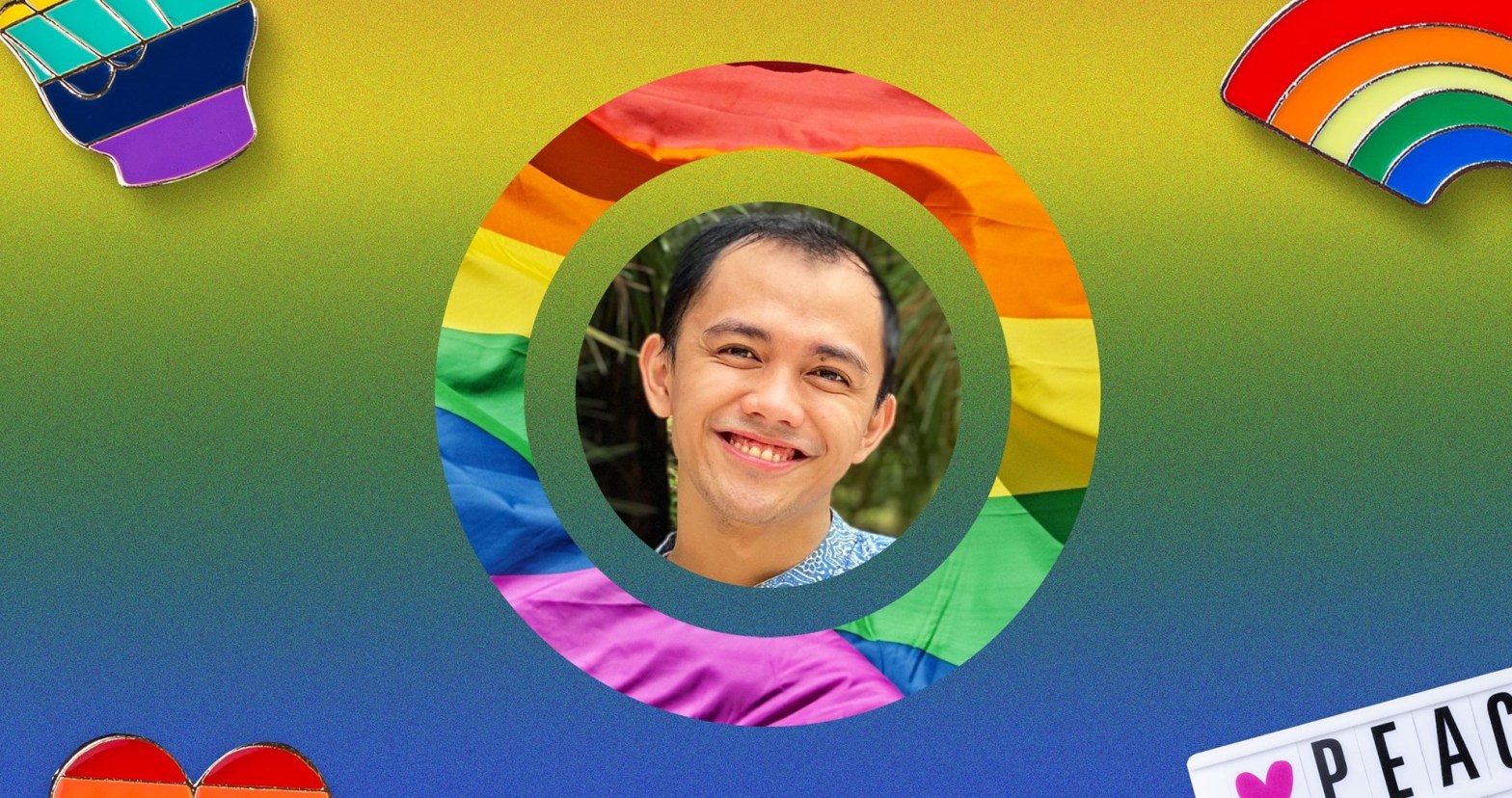
Thankfully, Climate Reality Leader Amiel Lopez graciously accepted our invitation to share his lived experiences, insights, and truths as a proud member of the LGBTQIA+ community and as a climate advocate.
 
A young Mindanawon dreamer, Amiel is a full-time MA Anthropology student at the Ateneo de Davao University. He works as a part-time college faculty under the same university and as a Climate Justice Researcher at Greenpeace Philippines. He is also the Co-Founder and Executive Director of Project Dyesabel—a non-profit, Bajau-and-youth-led organization that co-creates inclusive environmental initiatives through education and training, sustainable livelihood, research and innovation, and good governance.
 
In this feature, Amiel told us that we cannot truly achieve climate justice in the Philippines without ensuring equal rights for all vulnerable sectors of society, which include the LGBTQIA+ community.
 
We couldn’t agree more. For us in The Climate Reality Project, the pathway to a truly sustainable future for all includes undoing historic injustices and addressing systemic inequities.
 
To this end, we join Amiel and the rest of the Filipino people in calling for the enactment of a national anti-discrimination law that prohibits all forms of discrimination based on sexual orientation, gender identity and expression (SOGIE). We also vow to advocate for the inclusion of the LGBTQIA+ lens and the representation of LGBTQIA+ people in the climate justice movement. 
 

The impacts of climate change disproportionately affect the marginalized sectors of society, which includes the LGBTQIA+ community. How is the climate crisis compounding the struggles of the LGBTQIA+ community?


Amiel: Since then, the LGBTQIA+ community has faced a lot of discrimination that made them think of being unworthy to even lead and participate in any of the solutions towards the climate crisis. Nevertheless, they are now leading and participating in their own way. Whenever there is a typhoon, intense drought and rainfall, and other impacts of climate change, it is experienced and felt by those that are vulnerable, in this case, our LGBTQ+ community. What makes them vulnerable is the existing social stigma, inequalities, discrimination, and violence that are triggered when climate change-related events happen.

To put it concretely, whenever I am leading an environmental initiative and I get to become true with my gender and sexuality, some people would invalidate my efforts because I am more of a feminine. And as a “male,” I should not do things at the frontline or even be too emotional whenever climate disasters are felt on the ground. As a queer who led and participated in climate actions, I battle with me this fear of being discriminated and invalidated for what I have been actively doing. This is a reality for us in the LGBTQIA+ community. Every aspect of our being is being questioned or denied especially when climate change impacts us in the process. This [climate crisis] exacerbates the present social stigma and inequalities that we battle every single day.

Despite being vulnerable, the unique experience of the LGBTQIA+ community is often left out from the climate conversation. How do we ensure that future discussions and policy decisions will include the perspective of the LGBTQIA+ community? 


Amiel: To make sure that the perspective of the LGBTQIA+ community is included in policy decisions is to include them in the process of making such decisions. We don’t need just allies who ‘represent’ them. We need to ensure that there is a seat for them in those negotiations and allow their lived experiences and voices to be heard and included in the formulation of such policies.

If our government is really serious about having inclusive climate policies, they would consult all vulnerable sectors including our LGBTQIA+ community. But for them to really include us in the process, they should also promote the rights and welfare of the community not just in climate policies but also in the SOGIE Equality Bill that has been hampered for decades already.

If we really want to ensure that they are included, we see them as partners and leaders in these conversations towards environmental and social justice. Gone were the days that we think they are a sin, a curse, or any worse than a being. They are humans, too. We are humans, too.

 
"I believe that each of us has a seat on the table when discussing the challenges of our shared climate and our shared planet. Climate movements are now growing, with the awareness of intersectionality now going strong."
AMIEL LOPEZ

Across the globe, we see LGBTQIA+ climate justice advocates making significant strides for climate justice. In the Philippines, how are the power and voice of the LGBTQIA+ community uplifting and further advancing the climate movement?


Amiel: Because it is felt and experienced on the ground, regardless of sexual orientation, gender identity and expression, more and more vulnerable communities, such as the LGBTQIA+, are becoming more aware of the impacts of climate change and are pushing forward for climate justice. Because it affects us all, it is even more powerful when LGBTQIA+ demands climate justice along with social justice. These two are intrinsically connected. More and more LGBTQIA+ are at the forefront of these climate movements because they themselves are directly affected by the impacts of climate change.

I was a 10-year-old queer kid back then when I experienced firsthand a series of flooding in our village at the ceiling level of our house. I couldn’t share it with my friends because I was afraid to be discriminated against and invalidated for being gay and queer. Looking back, that pushed me to who I am now advocating for inclusivity at all aspects of our climate movement. I wanted to co-create a safe space for everyone including my own community to feel that all their climate stories are valid regardless of who they are. I wanted to make that 10-year-old queer kid self feel safe and free to express his/her/their climate story. I want to let my 10-year-old queer self that I matter and I am valued.

More so, because it is felt and experienced, I got to co-create and co-led my own organization—a Bajau-and-youth-led environmental organization that aims to make inclusive environmental initiatives. I believe that each of us has a seat on the table when discussing the challenges of our shared climate and our shared planet. Climate movements are now growing, with the awareness of intersectionality now going strong.

Broadening the scope of our climate activism to include social justice issues such as LGBTQIA+ rights is critical to ensure genuinely transitional climate justice. In your opinion, how does the Philippines fare on protecting LGBTQIA+ rights?


Amiel: As of the moment, protecting LGBTQIA+ rights is still a challenging reality for the Philippines. Without the passage of the SOGIE Bill, we are still far from achieving climate justice. As long as there is still a lesbian, gay, bisexual, transgender, queer, intersex, asexual, pansexual, etc. violated, discriminated, or invalidated in the Philippines amid the COVID-19 pandemic and climate crisis, we cannot have a genuinely transitional climate justice.

News are rampant on the LGBTQIA+ discrimination and violence. To be honest, upon writing my answers to the prompt questions and knowing that my audience would be my fellow Filipinos, I am afraid that I could be discriminated against and invalidated for being who I am and for sharing my truth. Not until the next kid would feel safe or valued or free to share his/her/their climate stories, the Philippines is far from protecting the LGBTQIA+ community’s rights and welfare.

 
"Each one of us has a SOGIE and it is important that we afford all beings in our country with equal rights."
AMIEL LOPEZ

What is your message to the government, especially policymakers, regarding the passage of the SOGIE Equality Bill?


Amiel: The SOGIE Equality Bill has been overly delayed for two decades already. It was first proposed in 2000 and I was born in 1999. Two decades later, I still face the existing social stigma expressed in discrimination, violence, and hatred towards me and my LGBTQIA+ community. Some of us die due to these prevailing social stigmas. This puts us so vulnerable to both social and environmental crises.

With this reality, I implore you to urgently pass the bill for us and for a better nation. This does not mean that we do not include the others because this is not a contestation of what sector shall be included but it is an attempt of allowing the LGBTQIA+ and all sectors to have equality, dignity, and justice for the years that we have been outstripped from it.

More so, I would not want the next generation to suffer the way we have suffered. This bill would mean a lot to those who have fought before us. As you read this, think of how beautiful it would be if all our sexual orientation, gender identity and expression are all celebrated and considered valid. 

Each one of us has a SOGIE and it is important that we afford all beings in our country with equal rights. What we have in common, regardless of our differences, is that we are all humans on a shared planet. This is your responsibility to the Filipino people. Do your part now.

Categories
Press Releases

LGBTQIA+ advocates: Climate change must be addressed through the lens of justice and intersectionality

LGBTQIA+ advocates: Climate change must be addressed through the lens of justice and intersectionality

Quezon City – The climate crisis is not just an environmental and development issue, but also a human rights issue that is indivisible to the sexual and gender minorities’ fight for equal rights and social justice.


This was highlighted during the special Pride Month episode of The Climate Reality Project’s Klimatotohanan webcast series entitled “Invisible, Ignored, and Ingenious: Lesbian, Gay, Bisexual, Transgender, Queer, Intersex, Asexual (LGBTQIA+) Pinoys in the Face of the Climate Crisis” which aired last June 19.

The episode featured Climate Reality Leaders, gender experts, and LGBTQIA+ advocates who underscored the need to address climate change through the lens of climate justice (linking the discourse on greenhouse gas emissions to equity and human rights) and intersectionality (recognizing that belonging to different social groups can affect the human experience, such as race, class, gender, and sexuality).

“For example, in preparedness efforts, they are not included in the list of government listing or any directory for aid or emergency response just because they do not fit the definition of a family—what the Philippines define as a family. So during disasters, they are unable to access government-provided relief or aid because they are not in that definition or category of what a family is,”
RACHEL BASAS, ASIAN DEVELOPMENT BANK

“The issue of gender recognition is a gender issue, but I think it is also a climate change issue,” said Ryan Silverio, Regional Coordinator for the ASEAN SOGIE (sexual orientation, gender identity, or expression) Caucus, a network advocating for the human rights of sexual and gender minorities throughout Southeast Asia.

Silverio said climate change has a direct impact on the lived realities of lesbian, gay, bisexual, transgender, intersex, and queer (LGBTIQ) persons, especially on the economic front.

“A lot of LGBTIQ folks work in precarious environments, working as freelance makeup artists, sex workers, etc. Because of discrimination, they can hardly find long-term jobs with security of tenure,” he said noting that sexual and gender minorities do not receive much support from the government when they lose their source of income in the aftermath of climate-related disasters.

“Climate change affects each and every one of us but its effect is not the same for all,” Rachel Basas, Climate Reality Leader and Gender Consultant at the Asian Development Bank explained, as she also discussed how the climate crisis is compounding the struggles of the LGBTQIA+ community.

According to Basas, the LGBTQIA+ community may not have access to crucial assets, resources, and information prior to, during, and in the aftermath of climate-related disasters.

“For example, in preparedness efforts, they are not included in the list of government listing or any directory for aid or emergency response just because they do not fit the definition of a family—what the Philippines define as a family. So during disasters, they are unable to access government-provided relief or aid because they are not in that definition or category of what a family is,” she explained.

“The passage of the SOGIE Equality Bill will enable us to plan for a rights-based and evidence-based response to climate-related disasters, the pandemic, and human rights violations,”
FERTH MANAYSAY, THE CLIMATE REALITY PROJECT PHILIPPINES

Adding another layer to these problems is the lack of representation.

“The LGBTQIA+ remains at the margins of policymaking offices and policymaking avenues. The voices are not heard. As such, the resulting policies, the resulting legislation, do not adequately respond to their needs. And that includes our climate and disaster policies,” Basas pointed out.

The Anti-Discrimination Bill, which aims to prevent discrimination against people based on sexual orientation, gender identity, or expression (SOGIE), has been languishing for two decades now in Congress.

“The passage of the SOGIE Equality Bill will enable us to plan for a rights-based and evidence-based response to climate-related disasters, the pandemic, and human rights violations,” Ferth Manaysay, Climate Reality Leader and Engagement Officer of the Climate Reality Philippines, pointed out during the webcast.

Manaysay, who served as the host for the said webcast episode, also emphasized the need to broaden the scope of climate activism to include social justice issues, such as LGBTQIA+ rights. “Doing so would ensure that we are pushing for a genuinely transitional climate justice,” he added.

Klimatotohanan is a fortnightly Facebook webcast that features conversations and discussions about climate governance, science, solutions, research, and other related topics. To watch more meaningful discussions about climate and sustainability solutions, watch the full episodes of Klimatotohanan here.

Categories
Blog Post

Policy Brief–Developing the National Bicycle Policy

Policy Brief–Developing the National Bicycle Policy

By: Genesis Kelly S. Lontoc

As the economy gradually opens up amid the pandemic, Filipinos keenly anticipate whether many of the “old normal” conditions will still hold true or whether new developments will prevail in the “new normal.” One of the challenges that would probably still be present would be the traffic situation. It is therefore an opportune time for the government to assess what it needs to continue doing, what it needs to stop doing and what it needs to start doing in addressing the issue of traffic.


Traffic hurts health through its impact on emissions that dampen the quality of the environment.

Mobile sources contribute the bulk of emissions both in the total country perspective and in the majority of the regions. The Environmental Management Bureau further adds that the major pollutants coming out of the mobile sources are Volatile Organic Compounds and Carbon Monoxide. The new normal ushers in a heightened sense of awareness in health. A healthy Philippines is where emissions can be addressed. Healthy citizens help build a wealthy economy.

Traffic also has a huge economic cost.

The long hours spent by people in traffic lead to a lot of lost productive labor hours and high opportunity costs. The Metro Manila Development Authority estimated that the traffic in Metro Manila cost the economy P3.5 billion daily in 2018. The Japan International Cooperation Agency adds that the daily number can escalate to P5.4 billion by 2035 if changes would not be implemented. A productive Philippines is where good traffic solutions help people save time.

Addressing the problem of traffic may imply having a wide array of plans and programs. However, one possible solution could be the passage of urgent legislation related to the development of a National Bicycle Policy. In terms of health, bicycles do not have harmful emissions unlike motorized vehicles. In terms of cost, regular bicycles are significantly cheaper than motorized vehicles. In terms of space in the road, bicycles occupy a lot less space than motorized vehicles. 

The National Bicycle Policy will hopefully provide the framework for bicycle policies and support programs to be coordinated well across the national and local governments. The Philippines can benchmark with how other progressive countries have been able to successfully draft and implement bicycle plans and programs. Government must liaise closely with various private sector stakeholders who have keen interest in biking so that the programs will be inclusive and realistic.

There must be a specific and accountable portion of the national budget and local government funds that must be allocated to the National Bicycle Policy. One major initiative that can be done is to increase the number of dedicated bicycle lanes and links in applicable major and minor roads. The budget can initially focus on the top regions where the mobile sources contribute the most to emissions. These are Region 9, Region 2, Region 13, Region 4B, Region 8, Region 4A and NCR.

To complement the bicycle road network, investments in necessary infrastructure projects should be earmarked toward structures and equipment that protect the collective safety of bikers, motorists and pedestrians. Parking facilities for bicycles must be provided in establishments. Fines can be imposed for road violators and the proceeds from fines can be utilized by the national and local governments to fund environment preservation, health care and other development programs. 

To further promote the use of bicycles, special loan facilities and special subsidy programs can be made available at the different local government units so that a good number of people can be influenced to adopt the healthier mode of transport. From a human capital view, the increased use of bicycles can improve wellness of people and may even spur more entrepreneurial activities.

Success of the National Bicycle Policy will entail sustained investment in terms of continuous educational awareness. Schools can incorporate in curricula the benefits of biking to the youth. Local governments can initiate seminars that tackle responsible biking and the importance of the environment and health. The national government can promote advocacy campaigns in popular communication platforms that will encourage people to explore bicycles as transport alternatives.

Clearly, for the Philippines to thrive economically, government and the citizenry should work well together in ensuring that both health and wealth improve in a sustainable manner. Promoting the active use of bicycles can help protect the environment, improve health and boost the economy.

***

Genesis is a Climate Reality Leader trained under the Global Training 2020 of the Climate Reality Leadership Corps. He currently serves as the Associate Chair of the Department of Economics of the Ateneo de Manila University.

This article was originally published on the Business Mirror on July 10, 2020. 

Categories
Press Releases

Youth leadership, capacity building, and education critical in reforestation and climate action, experts say

Youth leadership, capacity building, and education critical in reforestation and climate action, experts say

Quezon City — Youth leadership, capacity building, and awareness-raising play a critical role in advancing ecosystem restoration and climate action in the Southeast Asian region.


This was emphasized by forestry and conservation experts who are also trained Climate Reality Leaders from the Philippines and Indonesia during the World Environment Day episode of the Klimatotohanan webcast series, a fortnightly webcast hosted by The Climate Reality Project Philippines.

Anne Marie Mananquil-Bakker, Director for Partnerships at non-profit organization Fostering Education and Environment for Development (FEED) Philippines, highlighted the power of the youth to “build a better future.” She noted that young Filipinos and Indonesians have the ability to catch the attention of the media, which also plays an important part in amplifying calls for change and inciting action from the government and the private sector.

“To be honest, they [media] will respond when it comes from you, the youth. Don’t underestimate your power. Keep at it. Consolidate yourselves. Consolidate across the ASEAN region and then you have the voice for change,” Mananquil-Bakker told youth advocates.

Philippine forest cover is down to about only seven (7) million hectares or 23% of the country’s total land area from over 90% during pre-colonial times. Even with a National Greening Program and log ban in place, forest loss persists, and gains from reforestation efforts in some parts of the country are erased by losses in others.

“Capacity building is much needed in communities, [specifically on] things like agroforestry and simple techniques that have been around but the communities are not informed of,”
ANNE MARIE MANANQUIL-BAKKER, FOSTERING EDUCATION AND ENVIRONMENT FOR DEVELOPMENT PHILIPPINES

The 2019 Special Report on Climate Change and Land of the Intergovernmental Panel on Climate Change, the world’s top scientific body on climate change, has identified the forestry and land use sector as a significant net source of greenhouse gas emissions. Continuous deforestation and land degradation, however, will chip away at this carbon sink.

Raiza Mae Togado, Forest Monitoring Officer for the National Greening Program of the Philippine Department of Environment and Natural Resources, explained during the webcast that the key drivers of deforestation and forest degradation in the Philippines include agricultural and infrastructure expansion, land conversion, and climate change.

A lot of constraints in reforestation and forest conservation efforts, Mananquil-Bakker said, are caused by the lack of technical capabilities of different stakeholders and actors. “Capacity building is much needed in communities, [specifically on] things like agroforestry and simple techniques that have been around but the communities are not informed of,” she said. “Even things like carbon sequestration, if we can get more data in that area, then there’s even more impetus for the private sector to be involved,” she added.

Mananquil-Bakker also emphasized the need to ensure the sustainability, replicability, and scalability of reforestation and climate action projects moving forward. “What we try to design is a sustainable project that can be replicated in other parts of the country, can be scaled up, is designed on best practice for the community, by the community. All the science of development and forestry must be there. Otherwise, we shouldn’t do it,” she said.

“We cannot work in silos. We have to work together with communities that live near the forest to protect existing forests. We have to work with the government,”
MAHARDIKA PUTRA PURBA, ALAM SEHAT LESTARI

Deforestation rates in Indonesia hit a historic low in 2020 due to various government policies such as a permanent ban on the clearing of forests and peatlands, a moratorium on oil palm plantation licenses, forest fire mitigation, and a social forestry program. However, while Indonesia’s forest cover is at 50.9%, its Nationally Determined Contribution under the Paris Agreement allows up to 325,000 hectares of deforestation per year to supposedly leave room for economic development, potentially clearing 3.25 million hectares of rainforest by 2030.

Pointing out that the root of the problem is lack of awareness, Dr. Puji Rianti, environmental activist, researcher, and lecturer at the FMIPA IPB University in Indonesia, said that there is a need to educate the public on how forests, including everything in it, support not only those in nearby communities but also those living in the metropolitan areas.

Mahardika Putra Purba, Research and Program Consultant at Indonesia-based non-government organization Alam Sehat Lestari, meanwhile, underscored the need for all stakeholders from the private and public sector to converge efforts, expertise, and resources. “We cannot work in silos. We have to work together with communities that live near the forest to protect existing forests. We have to work with the government,” he noted.

This special Klimatotohanan episode, which aired last June 5, forms part of the Reimagine, Recreate, Restore campaign spearheaded by Youth Climate Reality Leaders of the Philippines and Indonesia. Aside from the Klimatotohanan webcast, the campaign features the Open Letter from the Youth and the Adopt-A-Seedling Donation Drive